Redistricting, priorities shared at Legislative Breakfast

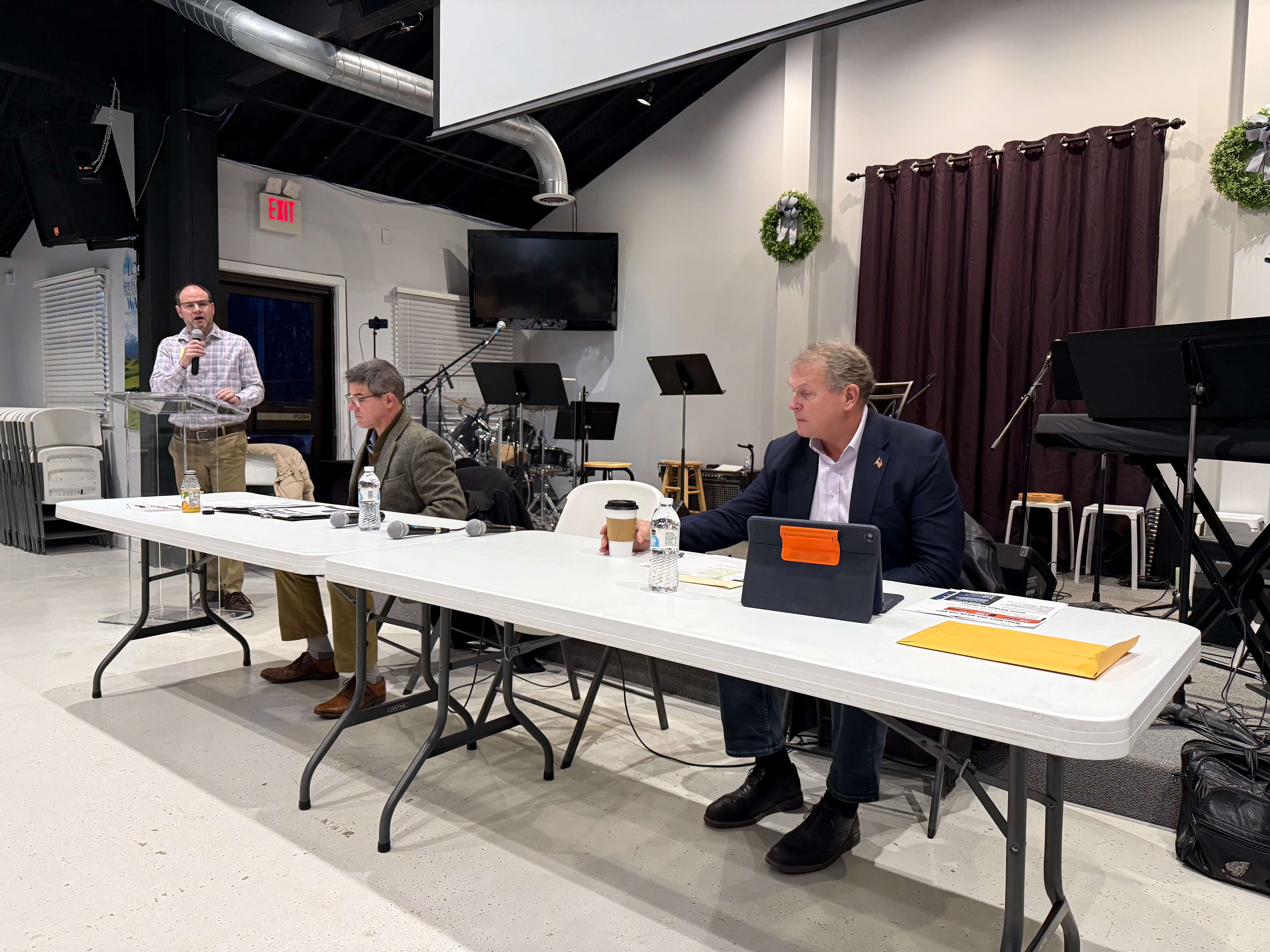
In addition to sharing information about the legislative priorities, Indiana's attempt to redistrict ahead of the 2026 mid-term election was also the center of conversation during the first of two legislative breakfasts hosted by the Owen County Chamber of Commerce. The event took place on Jan. 24.
The January legislative breakfast was sponsored by BBP Water Corp. and was hosted at Owen Valley Christian Fellowship. Main Street Coffee served as the event's coffee sponsor.
District 46 State Representative Bob Heaton and District 37 State Senator Rod Bray were in attendance. District 39 State Senator Eric Bassler was not at the event. County Councilman Anton Neff served as the moderator.
He began by introducing Bray and Heaton.
"The other thing I'd like to mention, if you'd like to follow along on certain subjects or certain legislation is to follow the state's website with their bill tracker and the resources that are available there," Neff said in his opening remarks. The website that Neff was referring to is www.iga.in.gov.
Neff also explained that this year is a shorter session because it is not a budget year for the state. Indiana's legislature drafts a two-year budget on odd numbered calendar years. During those years, the legislative session is approximately one month longer than the non-budget years.
This year, the session started early in December instead of its typical start in January.
Bray was the first to introduce himself. He said that the "short" session years, or non-budgetary years are typically finished by Mar. 15.
"This is not exactly a shorter session. We just started a different time," he said. "We came in in December to address the issue of redistricting and spent about two weeks in session then. Because of that, we're basically taking two weeks off at the end of the legislative session. So we will be finished with our work by about Feb. 27 of this year, which is approximately two weeks earlier than we would be in a short session."
He then highlighted the priorities of the Senate. Bray, who is a Republican, is the President Pro Tempore.
One of those priorities was Senate Bill 1.
"It works in the space of Medicaid and SNAP (Supplemental Nutrition Assistance Program) trying to make sure that that program is executed with integrity and fidelity so that the people that need those programs are getting those programs," Bray said.
He said that the state has had issues with folks receiving the benefits despite making more than the allowed income threshold.
"Medicaid is a fantastic program, but it's been growing at an unsustainable rate, so we want to make sure that we're executing that with as much fidelity as absolutely possible," Bray said. "This bill does a couple of other things, and it kind of works with the federal Big Beautiful Bill. It passed over the summer, last summer."
Bray also highlighted the effort to improve healthcare across rural Indiana.
He also highlighted a constitutional amendment resolution which would be placed on the ballot in November's general election if it passes both the Indiana House and Senate.
That amendment would expand the reasons that a judge could hold the accused without bail. Currently, judges can only hold those accused of crimes without bail if they are accused of murder or treason. The amendment would allow for judges to hold the accused without bail if there is strong, clear and convincing evidence of both the person's guilt and that there is no condition of the bond that can be placed that will help keep society safe. Hearings would still be required for this to ensure due process.
"So those are the couple things that I'll highlight as our priorities. I'm sure we'll talk about lots of other things because as I've said before, when we come here to Owen County, we talk about an array of different things. That's one of the reasons I enjoy coming here so much," Bray said.
Heaton then took a moment for his opening remarks, starting with saying that it is an honor to serve with Bray and recalling an experience of the two walking in the parade at the Gosport Lazy Days festival.
"Rod and I were there, and I think your son and you brought your dog with you," Heaton began.
"She's much more popular than I am," Bray said.
Heaton continued setting the scene in which someone yelled out, "Hey, Tom Cruise."
"And I look back and he's talking to Rod about that. So I tell you what, Rod Bray, Tom Cruise, whatever, it's good to serve with you," Heaton said.
He then talked about the difference in topics that come up when he visits the various counties in his district.
"Everybody's got their different viewpoints and issues within their county and district," Heaton said.
He said that addressing the Medicaid spending is also a priority for the House. Heaton, who is also a Republican, serves as the majority whip for the Indiana House of Representatives.
He said that 22 percent of the $44.5 billion two-year budget goes to Medicaid.
"Twelve years ago, that was about 10 percent," he said.
Heaton also brought up House Bill 1414, which deals with cutting trees in the state forests and bills to cut or eliminate township government. There was a bill that originated in the House as well as a suggested point system proposed in Senate Bill 270.
"It's trying to make local government more efficient. It's not eliminating all townships and that type of thing. It really affects my district, maybe two or three townships," he said. He added that he has approximately 23 townships throughout his district.
After the opening comments, the event went into questions and comments from constituents, which covered a myriad of topics.
At one point, redistricting and the fact that it did not pass the Indiana Senate came up. It did pass the Indiana House of Representatives.
Bray addressed the matter and why he did not vote in favor of redistricting, despite pressure from the federal government.
"It didn't feel like the right thing to do for Indiana for a couple of reasons. First of all, I'll say that the idea that we could go from seven to two, where we are right now, and then just simply flip a switch and go to nine to zero is fiction. I don't think we can get that done," he said.
He explained why he believed it to be fiction.
"You'd have to take the Democrats that are concentrated in Marion County and Lake County and disperse them around into other congressional districts. So you would, by definition, weaken every other congressional district in the state, and you would make those people, those concurrent sitting congressional delegations, to run in districts that they have never run in before. And then you presume that you've got people that are going to sign up and run for Senate congressional district one and seven, which are the two that are held by Democrats right now. There's no preeminent candidate for that. Even today, there's not a preeminent candidate to run for those two seats. They haven't walked in a parade. They haven't gone to a fair. They haven't eaten a tenderloin with constituents in any part of the district at this point. They haven't raised a dollar of money," he said. "So I think it's fiction to think that all of a sudden we can turn that into nine zero, and that's a big part of the reason."
Bray also said that he was contacted by many of his constituents and that for every 10 that were against the mid-cycle redistricting, he only had one that was in favor of it.
"That was a big part of my decision as well," he said.
He then addressed the notion that he rallied the Indiana Senate and the Senate Republicans against redistricting.
"With regard to 'I put my caucus against it,' that is inaccurate. The people who made that allegation, including the (U.S.) Vice President (JD Vance), I've spoken to him a couple of times about this issue, and that's not how I lead my caucus," he said. "It's the honor of my life to be the President Pro Tem in the Senate. I lead by consensus. We work together to figure out what the right thing to do is. The people that decided they were for it were for it. I gave them no pressure or punishment whatsoever. The people that weren't for it, it was their decision completely, and that's where the Senate landed."
Other topics addressed during the legislative breakfast included: concerns about the legislation proposed to eliminate several elected county offices to be appointed by county commissioners; Senate Bill 182, which is known as the birth certificate bathroom bill; increasing beginning and overall teachers pay; extending the deer shotgun hunting season; repairs to the McCormick's Creek State Park campground; and forestry management at Indiana state parks and forests, especially at Owen-Putnam State Forest.
The next legislative breakfast will take place at 7:30 a.m. Feb. 28 at Owen Valley Christian Fellowship, 338 S.R. 43S, Spencer.