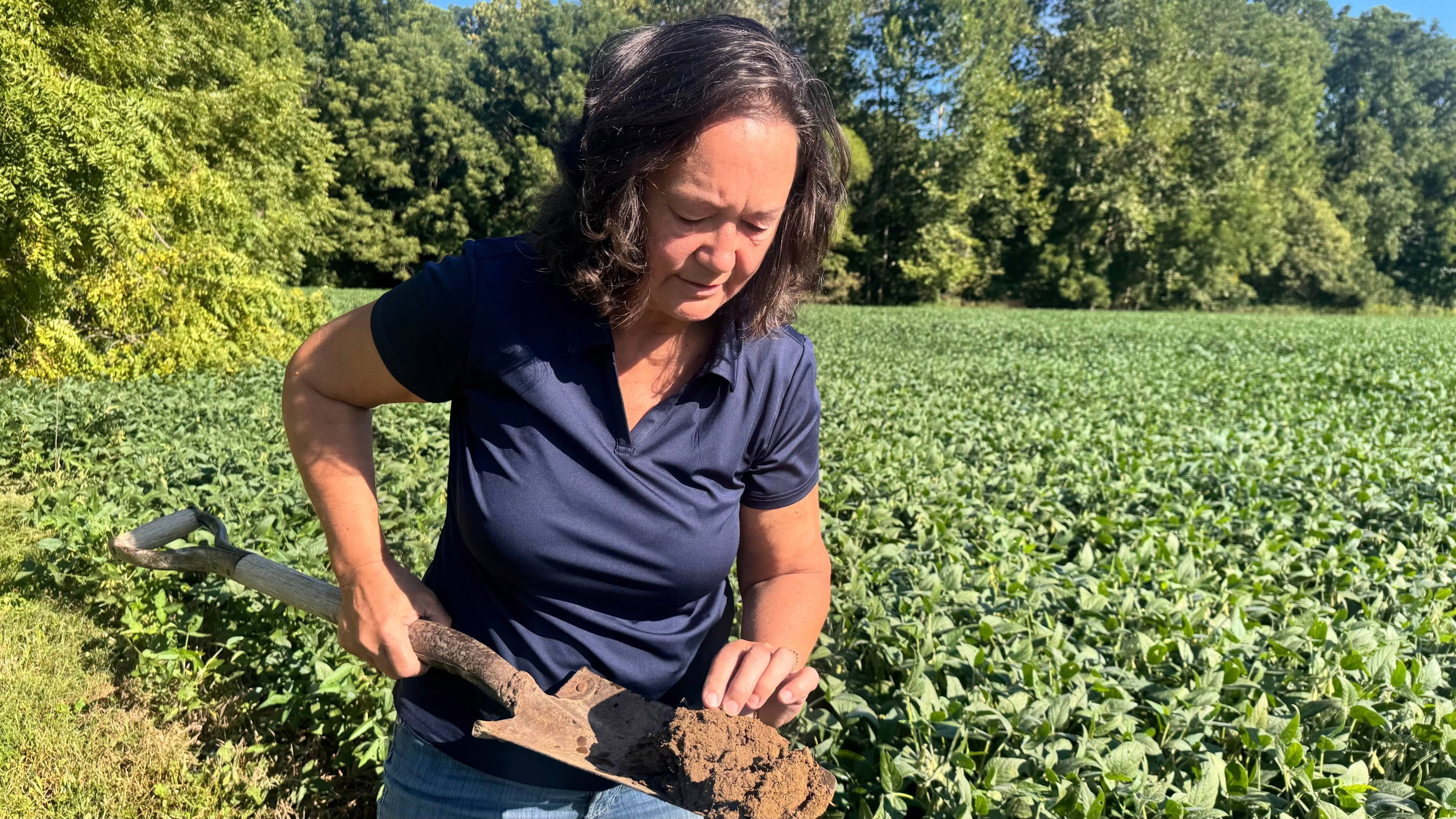
Three decades of silence: The unsolved murder of Bryan Haltom


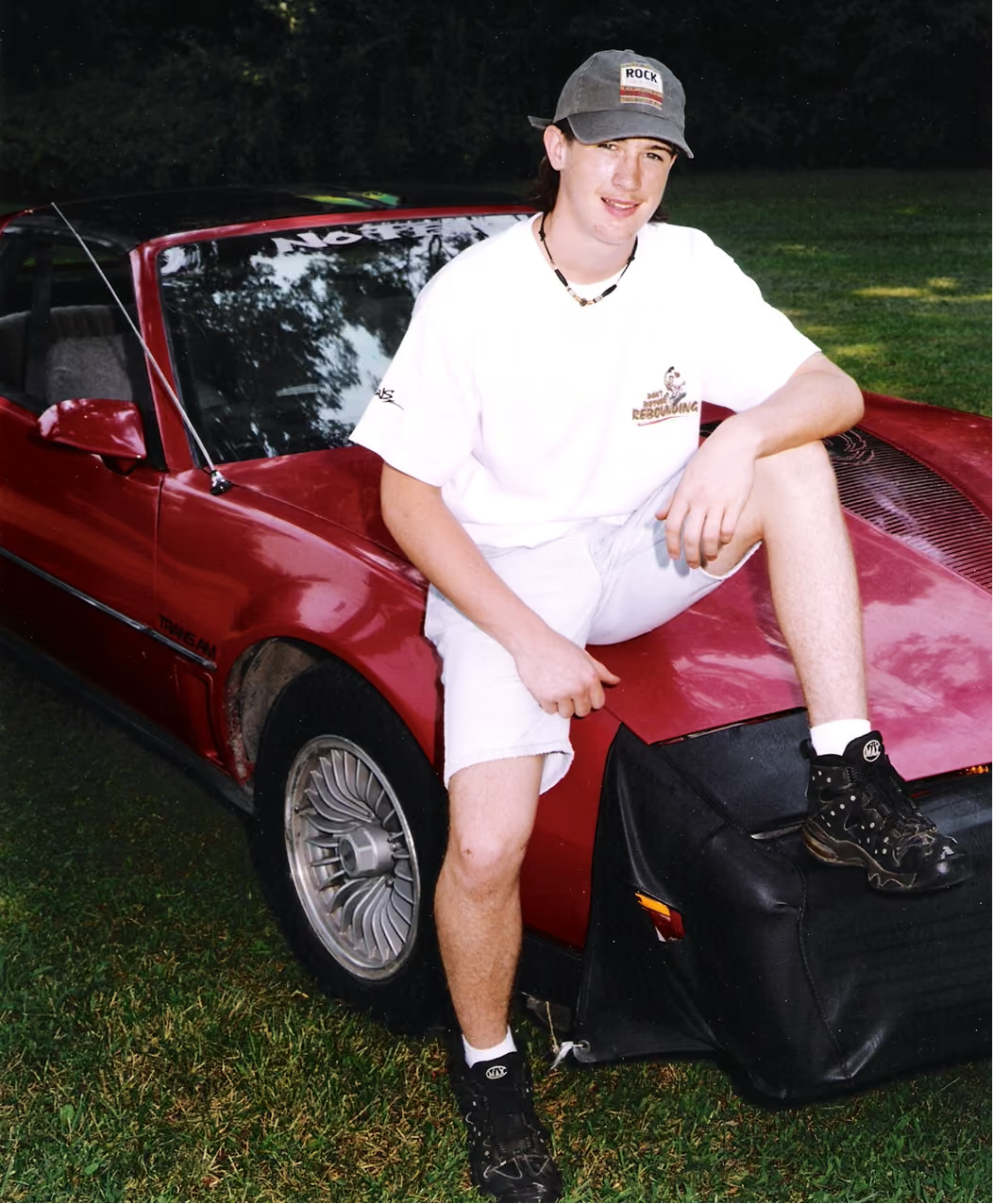
Thirty years have passed since the headlights of a red Pontiac Trans Am cut through the night air on U.S. 231/67 just north of Spencer. There, a single gunshot shattered the quiet of July 17, 1996, cutting short the life of 18-year-old Bryan Edward Haltom and leaving an enduring wound in the heart of Owen County.
Today, the case remains one of the area’s most prominent unsolved mysteries—a stack of files transferred years ago from local custody to the Indiana State Police. For Haltom’s mother, Lynn Carmichael Highland, the passage of time hasn’t faded the memory of her fun-loving son, who was born on Christmas Day, 1977, nor has it quieted the agonizing questions that have lingered for half a lifetime.
Before he walked out the door that night during what was a typically busy county fair week, a mother and son shared a familiar, lighthearted exchange.
“We used to say… we’d do the ‘I love you more’ thing,” Highland shared in a recent retrospective interview from her home in Florida where she lives with her husband, Tom Highland. “That’s the last thing I said to him, I said ‘have fun, I love you more.’ That was it. I’m just so thankful we weren’t arguing over anything though. I see so many parents that, you know, they’re arguing with their child... but they leave. And you know, that’s the last time they see them. And I’m so grateful we weren’t fighting.”
Late to the wheel
Given his father Ed Haltom’s background as a mechanic, it seemed almost inevitable that Bryan Haltom would develop a passion for cars—even if it took him a little longer than most teenagers to get behind the wheel. When he finally showed an interest in driving at 17, his parents began searching for a reliable vehicle.
“His dad was a mechanic, but Bryan didn’t actually get his license until he was about 17,” Highland recalled. “He really wasn’t interested in getting it right when he turned 16, and he didn’t even take driver’s ed. I think I was more interested in him getting it than he was, just so I could quit bussing him around while his dad and I were working.”
When the time came to pick out a vehicle, a clash of styles quickly emerged. While his mother had a sensible, practical vehicle in mind, Haltom had entirely different ideas about what his first set of wheels should look like.
“When he finally got interested, we started looking for a car. I definitely wanted him to get a Volkswagen Beetle, and he was like, ‘No way, Mom,’” Highland said.
The standoff didn’t last long. A chance conversation at work opened the door to an affordable compromise that combined a teenager’s dream car with a project his mechanic father could easily handle.
“Around that time, I was talking to a coworker at Boston Scientific who had a Pontiac Trans Am for sale,” Highland explained. “I told her I was looking for a car for Bryan and asked what she wanted for it. It wasn’t much at all—only about $1,000 or $1,500, because it had been wrecked a little bit in the front. It had a bra over the front that covered the damage, so it didn’t really make a difference, and Ed could fix anything wrong with it mechanically.”
Any lingering thoughts of a practical Volkswagen vanished the moment Haltom laid eyes on the red sports car. It was, his mom recalled, love at first sight.
“When we went out to look at it, Bryan’s eyes got huge. There went the VW right out the window,” Highland said. “We bought it from her, and he just fell in love with it. It had T-tops, and it was a four-speed, so Ed taught him how to drive it. We brought it home, and that was his car.”
A fateful ride and competing accounts
The evening of July 16, 1996, began like many others during an Indiana summer. The Owen County Fair was drawing crowds of teenagers into town, and though Haltom had initially planned to stay home, he headed out to meet friends after a phone call, agreeing to an 11 p.m. curfew his mom recalled.
Later that night, Haltom reportedly connected with Trevor Powell in the parking lot of Fulk’s OV Restaurant (today the site of Byers Home Furnishings). Powell was described by Highland as more of a casual acquaintance than a close friend.
According to early statements provided to police by Powell, the sequence of events that followed was framed as an escalating teenage night. Powell contended that they were traveling in Haltom’s Trans Am when another vehicle—described as a sporty maroon or dark red import—struck or passed them near Main and Morgan streets.
According to Powell’s original account, an angered Haltom allegedly ran a red light, sped up to catch the maroon car, turned north on Fletcher Ave., passed it and pulled onto the shoulder less than a mile north of State Road 46. Powell claimed Haltom then exited his vehicle and walked back toward the trailing car, where a shot was fired from within the suspect vehicle, striking Haltom in the chest. Investigative files later revealed the weapon used was believed to be a .38 caliber semi-automatic handgun.
For decades, Haltom’s family has found this road-rage sequence difficult to accept. Bryan’s father publicly doubted the logistics of that timeline.
“I still don’t believe what he’s telling me... you run a car 80 miles an hour down through the middle of town, somebody’s going to notice,” Ed Haltom noted in a 2000 interview printed in The Spencer Evening World. “It would be difficult for any car to wait completely through a red light at Main and Morgan and catch up with a second vehicle by Fletcher.”
Dispatch chaos and the midnight hunt
Archival accounts from the first responding officers paint a vivid picture of the immediate, chaotic aftermath of the shooting. Former Owen County Sheriff’s Department Chief Deputy Joe Pettijohn recalled that the fair had just wound down when the call fractured the night.
“Everyone had dispersed from the fair; I was off and hadn’t been home more than 30 minutes, and I got a call from dispatch,” Pettijohn noted in an interview with The Spencer Evening World in 2011. “They told me they had a shooting on Epitomist Hill (just north of Boston Scientific), and they had a report that the suspect was driving a red mid-sized car, no make or model, and headed north.”
Pettijohn immediately mobilized toward Gosport, parking just past where the Casey’s General Store stands today. Meanwhile, Sheriff Steve Cradick dispatched every available unit to strategic county lines.
“All notifications were made to area emergency personnel, Spencer Police and the sheriff’s department,” Pettijohn recalled. “All we knew was we were looking for a red, mid-sized car. Ellettsville, Bloomington, Greene County, Morgan County, Putnam County, all of the notifications were made... everybody was looking for a red car... we would have probably stopped a red Volkswagen even.”
Despite the massive net cast across southern Indiana, the shooter slipped away. Indiana State Police Evidence Technician J.D. Maxwell arrived on the scene shortly after the shooting, according to previous accounts, confirming the road was locked down north and south, but the suspected vehicle’s direction of travel was eventually reported as changing toward the south.
Powell’s early description of the gunman was documented: a well-built male, roughly 30-years-old at the time, with dark hair and a two-day-old beard. Yet, as years dragged into decades, street gossip contaminated the official record.
“You had all kinds of people calling in saying, ‘I think so and so did it,’” Pettijohn lamented. “Word of mouth travels around... People just made their own assumptions. There was only one known witness to the crime.”
Pettijohn, who served with the sheriff’s department for more than 20 years before retiring, passed away on April 16, 2026, at the age of 63.
A mistaken accident, a shocking truth
The evening began normally, with Haltom leaving the house in the late afternoon. Highland recalled the timeline of that night and her strict rules regarding her son’s curfew.
“Bryan left the house at approximately 4 to 4:15 p.m. I had to be at work the next morning, so by 10 p.m., I went to bed. I usually got up at 5 [a.m.]. When I told him to be home at a [certain] time, he better be home at that time or I’d take his car keys and he’d be grounded,” she said. “Not everyone had a cell phone then, so I always worried about him. Bryan was rarely ever late. If he was, he always had a good reason, and if he could get to a phone he called.”
As midnight approached, his dad grew anxious when his son failed to return home. While Highland said the police later claimed they tried to call the house, she disputed their account.
“Ed was outside working on a truck. Around 12 a.m., Ed came in and woke me to tell me Bryan wasn’t home yet,” Highland recalled. “He was worried that maybe he should go in [to town] and look. I looked at the clock and said to give him a few more minutes, that he must have had car trouble—a flat tire or something. Ed ended up falling asleep in the recliner, and we both fell asleep. The cops later said that they tried to call us and our phone was off the hook, which was very, very strange. I honestly never did believe it; our phone was not off the hook.”
The quiet night was abruptly shattered around 1:30 a.m. when their niece, Cindy Collins—who had been sent by family after the sheriff’s department notified them—came rushing into the unlocked home.
“Cindy came running through the door, screaming, ‘You have to get to the hospital, Bryan has been in an accident.’ It was July 17th so it’s hot, and we never locked doors or anything. She said, ‘You have to go through Gosport, don’t go into Spencer,’ Highland recalled. “We pulled on our clothes and ran out the door. As we pulled up to the intersection at the end of Coon Path, there were firemen directing traffic. They knew who we were and told us to go through Gosport too. They said they weren’t sure what happened but to hurry. We raced all the way to Bloomington Hospital. We thought it was a car accident, and he wrapped himself around a tree in that damn car.”
Upon arriving at Bloomington Hospital, Highland ran inside to handle the paperwork, completely unaware of the violent nature of the incident until a doctor delivered the devastating news.
“When we got to the hospital, Steve Craddick [Owen County Sheriff] pulled in right behind us. Ed said, ‘I’m gonna go talk to Steve,’ and I went on in ’cause I’m the one that carried the insurance,” Highland said. “The doctor walked up, introduced himself, and stated very matter-of-factly, ‘Your son has been shot to death.’ Bryan had been shot through the heart.”
Sifting through small-town rumors
In the long absence of an arrest, local whispers grew increasingly complex. One prominent theory explored by the family involved a Stinesville man who had befriended area teenagers and was later arrested on unrelated drug and sexual misconduct charges. Rumors surfaced alleging that Haltom was on the verge of exposing the man’s illicit activities to authorities, prompting a retaliatory, paid hit.
Other persistent theories involved illicit drugs and even local political interference. While the barrage of gossip was exhausting, Highland viewed the community talk as a double-edged sword.
“In those rumors -- somewhere -- is the truth. It’s just a matter of following each one of them and find where the truth lays,” Highland stated in 2000. “And as a parent, you don’t want your son to be forgotten. At least if the rumors are going on, (the murder is) not being forgotten.”
Shadows on the highway
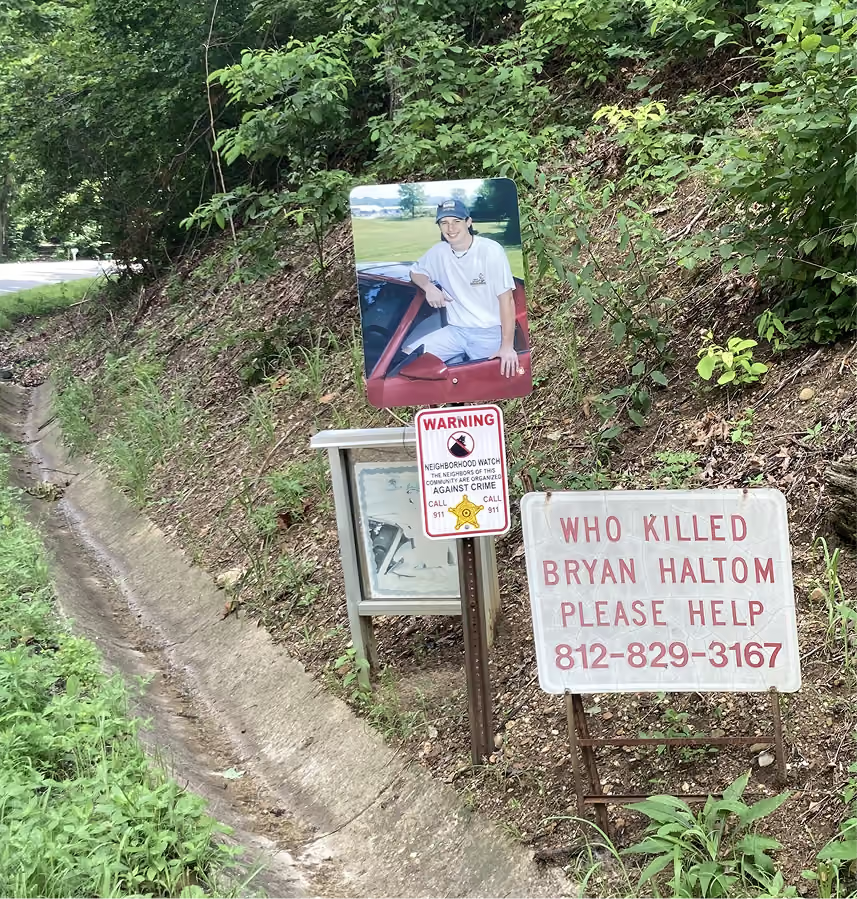
Archival records reveal that local law enforcement did encounter bizarre developments along the way. Around the time of the 11th anniversary in 2007, Indiana State Police Sgt. Jeff Deckard revealed a strange occurrence where a file folder scrawled with a specific individual’s name was found physically attached to Haltom’s roadside memorial cross north of Spencer.
Furthermore, first responders recalled unusual activity near the scene on the night of the crime. Former Owen County Sheriff’s Department Detective William Snodgrass, one of the first officers to arrive, noted that within 15 minutes of police arrival, a large group of local teenagers had gathered just down the road. Snodgrass noted in 2007, “It just seemed unlikely... maybe someone in that group that night knew more than they were willing to share with police.”
Snodgrass, now a Major with the sheriff’s department, today serves as Commander of the Owen County Jail.
Highland also recalled a localized lead regarding a nearby ditch. A resident living near the site contacted her to report seeing an individual pacing the ditch the morning after the shooting, appearing to look for a discarded object. Though the sheriff’s department searched the area with metal detectors, no weapon was ever recovered, she said.
Waiting on a witness
With the passage of time and the absence of key physical evidence, the path to justice in Haltom’s case has grown increasingly narrow. Fearing early investigative missteps and a lack of a physical weapon have limited the role that modern forensics can play, Highland believes the resolution of the mystery is likely to hinge entirely on human breakthrough rather than laboratory science.
“Oh, I think it is going to take a witness. If the person who knows what happened isn’t dead already—which is what concerns me—it’s not going to be solved through DNA or anything like that,” she said. “There is nothing really left. We never found a gun, and they screwed up the ballistics of it all. So ultimately, it’s going to take somebody finally breaking their silence.”
Left in the dark
Highland remains profoundly frustrated by the lack of communication and perceived stonewalling from investigators tasked with solving the case. When asked if she maintains contact with the law enforcement agencies overseeing the active investigation into her son’s death, Highland revealed a perceived rift between local efforts and the state authorities who now control the file.
“They gave Sam [Hobbs] an incredibly hard time when he was sheriff,” Highland said, noting she believes the perceived pushback severely hindered local progress. “Sam did all kinds of legwork on Bryan’s case and they just, oh, they just gave him such a hard time about it and wouldn’t let him do all kinds of things.”
According to Highland, the jurisdictional handoff has left her completely in the dark regarding any potential breakthroughs or updates.
“[Sheriff] Ryan [White] told me it’s not under Owen County anymore. It hasn’t been for years,” she explained. “But yet the State Police have absolutely no contact with me whatsoever—they haven’t talked to me in at least 20 years.”
Investigation shifted to Cold Case Team
The investigation has officially transitioned to a specialized state unit, according to Sheriff White. White confirmed on July 12 that the case was handed over to the Indiana State Police (ISP) Cold Case Team approximately three to four months ago. While White stressed that the extensive volume of evidence means a quick resolution is unlikely, he emphasized that lines of communication remain open.
“The case belonged to the Indiana State Police three days after the murder occurred, so it’s not been part of the sheriff’s office other than those first three days,” White said. “However, I did meet with the state police detective this past week regarding the case and discussed some key points that I thought needed to be looked at. Bryan‘s case has been turned over to the Cold Case Team with the Indiana State Police. There’s a lot to look at, so I’m sure it will not be quick. They have a lot of information to review before they can act on anything. I can’t discuss specifics regarding the case, but folks with information to share can contact me at my office, and I can share it with the ISP.”
A ‘mama’s boy’ frozen at 18
While the paper files and police logs focus on the logistics of a crime scene, Highland’s mind constantly returns to the vibrant, fun-loving teenager who filled her home with life. Three decades later, she still pictures the boy who loved high-energy summer nights and shared a unique, tender bond with his family.
“He was a mama’s boy, even if he wouldn’t admit it,” Highland smiled, recalling his protective yet affectionate nature.
Stolen on a dark stretch of U.S. 231 three decades ago, Haltom’s missing milestones leave an empty space that Highland frequently fills by imagining his unlived life—the career he would have built, the partner he would have chosen and the family that should have been.
“I wonder all the time,” Highland shared, her voice carrying the quiet weight of three decades of unfulfilled dreams. “You know, about his kids... what they would look like, who he would be today.”
A mother’s final plea
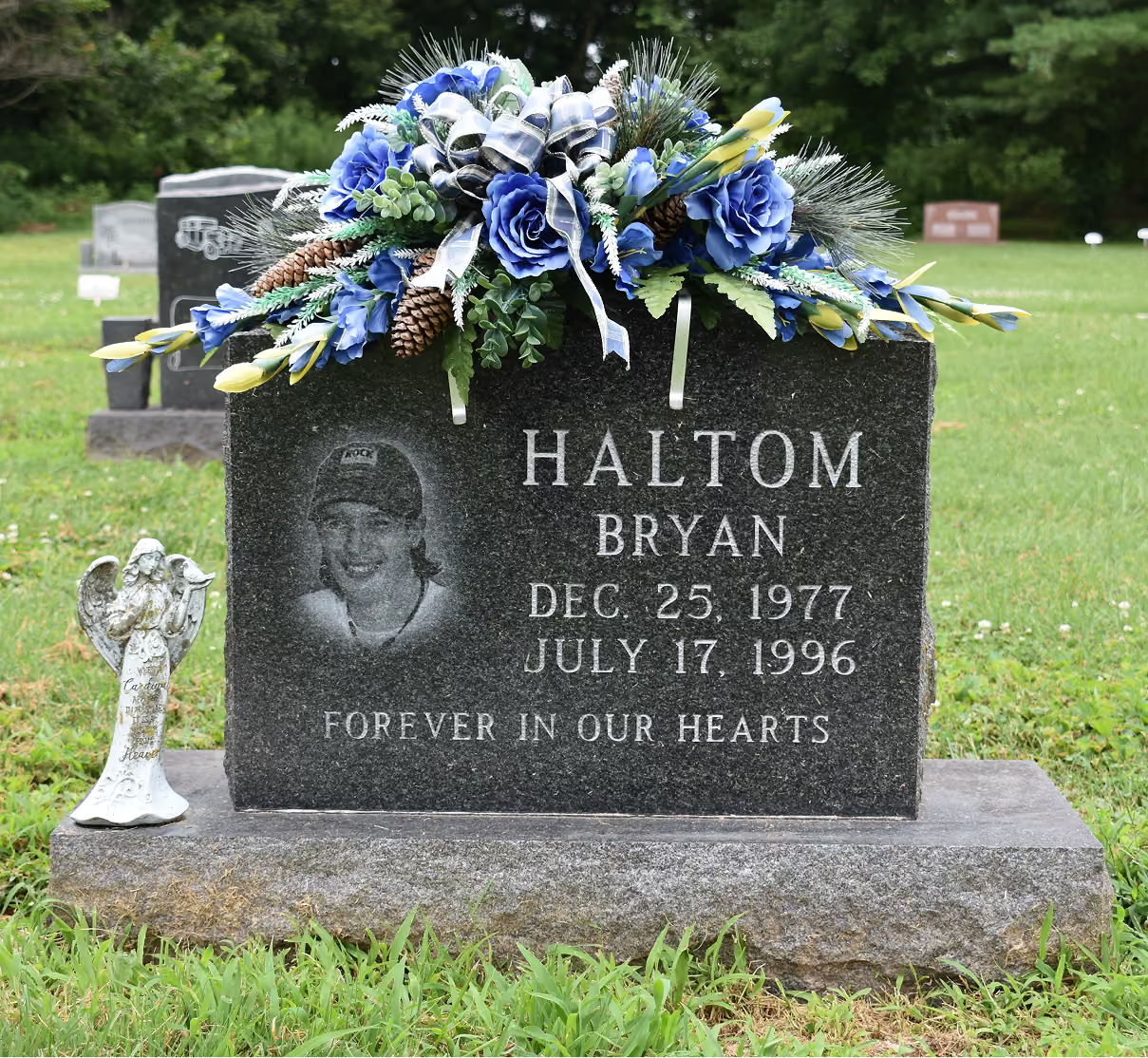
Today, Haltom rests in Riverside Cemetery. Years ago, Highland replaced his original limestone marker with a permanent black marble headstone bearing his etched photograph and the words “Love You More” carved on the back side of the stone.
As she navigates her 69th year, the lack of closure weighs heavily on Highland, compounded by the fear that she or her 86-year-old mother may pass away before justice is served.
“There is not a day that goes by that I don’t think of Bryan. Not one day. And there’s not very many days that I don’t think of the case,” Highland shared. “I want justice before I die. And I just don’t know if I’m gonna get it... The next time I go [to Indiana], I hope I’m in that damn courthouse. Yeah, that’s where I wanna be.”
With an independent investigative podcast slated to be released near the 30th anniversary of the tragedy, Highland hopes a human conscience will finally break the decades of silence.
“If it’s a stranger that got away with it, it’s like, how could you just turn and run like that? You just changed our lives forever,” Highland said. “But, if it’s somebody that knew Bryan, knew us… how does he do that to us? To leave us hanging… all these years of not knowing what happened, cause the not knowing what happened is probably… it’s almost harder than losing Bryan.”
Three decades after losing her son, Highland wants the public conversation to shift away from the small-town rumors that clouded the investigation and return to the person she believes her son truly was. As the community marks this milestone anniversary, she hopes readers will look past the gossip and remember a young man defined by his kindness rather than the myths that followed his death.
“I want them to remember him like he really was. He was a truly kind kid,” she said. “I want people not to go off the rumors they heard about drugs and everything, because that wasn’t the kind of person he was. The rumors that went around back then were just horrible, and they simply weren’t who he was.”
Anyone with information regarding the July 17, 1996, shooting death of Bryan Edward Haltom is urged to contact the OCSD at 812-829-5757, or the Indiana State Police Bloomington Post at 812-332-4411. Callers may remain anonymous.