County files civil lawsuit, Open Door Law questions emerge over how action was authorized

A civil tort filed by the county against a local resident raises questions under the Indiana Open Door Law, with no record of the action being authorized in a public meeting and no explanation from officials about when or how the decision was made.
The lawsuit was filed in Circuit Court II by Owen County’s County Attorney Tony Overholt on April 13 against local resident Pamela Rogers.
Rogers is also a candidate for county surveyor on the Republican ticket against incumbent Amy Meier.
The complaint for declaratory judgement and permanent injunction claims that “in January 2025, Rogers began a campaign to overwhelm employees of Owen County with public records requests, other requests for information and complaints about county government.”
It also says that since that time, Rogers has sent more than 6,600 emails to 200 recipients associated with Owen County.
Those individuals, according to the filing, have received more than 44,000 emails from Rogers’ personal email account. The filing also states that each request requires review from one or more county employees in a county with limited resources.
Rogers said that she believes the number is a fraction of that. She also said that the number likely counts each recipient copied on the email and that she was asked to copy all seven members of the county council instead of just their president and vice president.
“Owen County currently employs only a small number of people in administrative roles who respond to public records and other inquiries,” the filing reads. “Rogers’ deluge of emails—likely sent using an automated system or process or with the aid of such a system or process—interferes with Owen County’s responsibilities and impairs its ability to assist other residents.”
Rogers also has said that she only uses voice to text to help with typing and that she does not use any automated system or process.
The filing has two counts. The first concerns public records requests.
Count one requests that the court require Rogers to submit all future public records requests utilizing a specified form submitted in person, via mail or through a commercial third-party carrier.
“Owen County does not seek to curtail Rogers’ rights under ARPA (Indiana Access to Public Records Act), the United States Constitution or the Indiana Constitution,” the filing reads. “Rather, Owen County requests only a declaration that it may lawfully restrict the form of Rogers’ public records requests so that Owen County may serve all its residents.”
The first count also requests for reasonable costs of bringing the action.
The second count concerns whether or not it constitutes a nuisance.
“Through her constant and repetitive emailing of Owen County’s public officials, Rogers obstructs the free use of Owen County’s information technology systems and interferes with the use and enjoyment of those systems,” the filing reads under count two. “Rogers’ conduct also interferes with Owen County’s ability to deliver services to Owen County residents, thus interfering with a right common to the general public.”
The filing alleges that this is a nuisance and requests a permanent injunction prohibiting Rogers from communicating with Owen County officials by email and allowing the county to block emails sent from any email address owned or controlled by Rogers.
It also requests reasonable costs and attorneys’ fees for bringing the action along with all other appropriate relief.
Under Indiana trial rules, Rogers has until May 4, the day before the primary election to respond to the lawsuit.
Since the initial reporting, County Council President Polly Chesser has said that the council did not know the lawsuit was in the works and that they were not involved in making the decision.
She said she was first informed of it via text message from Rogers, and Chesser said a percentage of the emails were sent to the county council yet they were not involved.
“We didn’t know anything about it. We were not conferred with; nothing,” Chesser said.
She said that if she had been asked, her opinion is that she would not be in favor of the civil tort filed against Rogers.
“We have no extra money to be doing this with,” Chesser said. “I’m pissed as a taxpayer, and I’m pissed as a council member because this is ridiculous.”
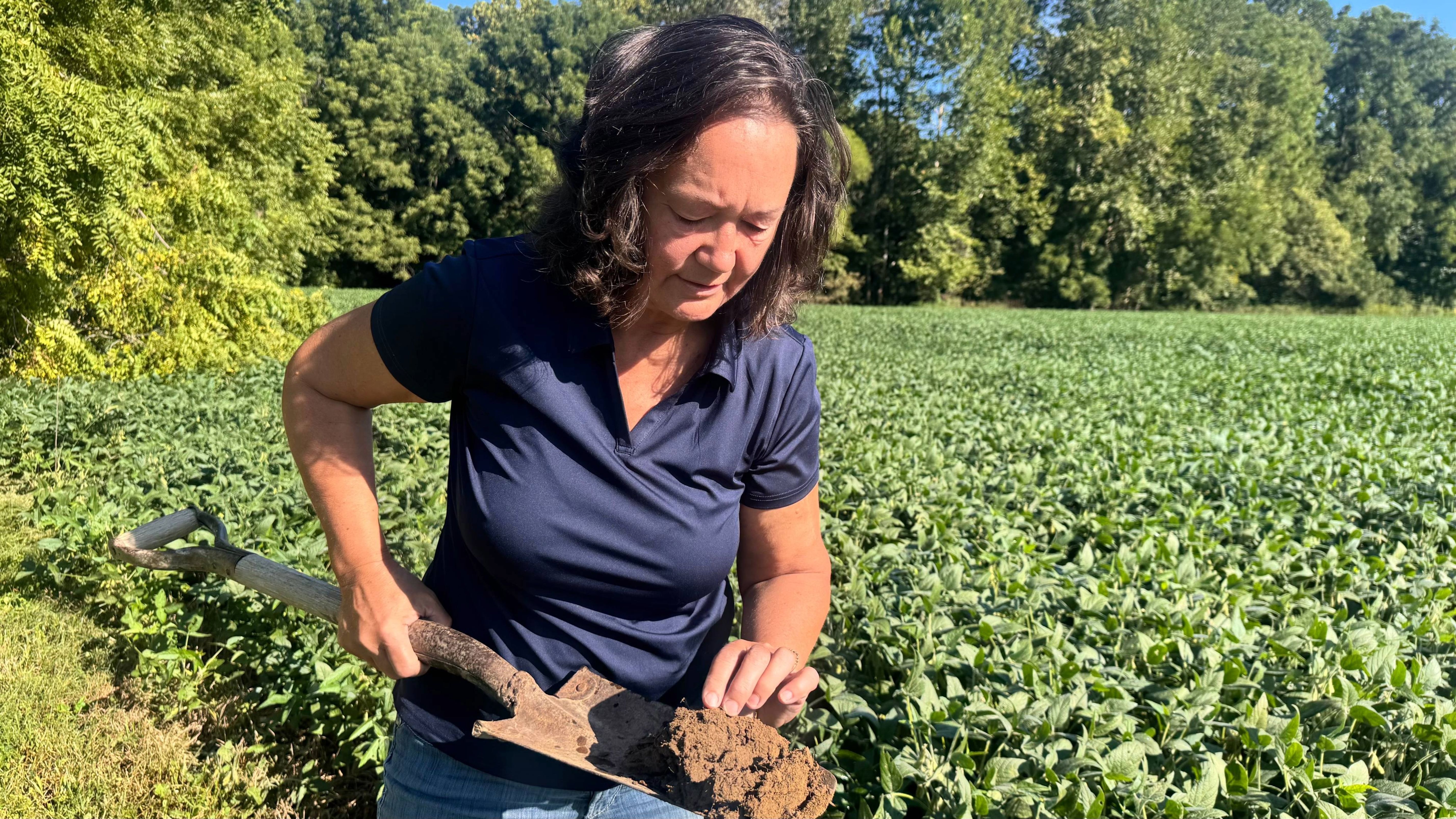
Who is Pam Rogers?
Rogers moved to Owen County in 2017 after she retired.
The home that she bought on Kelly Farm Place was part of one of the subdivisions from the late 1990s to early 2000s in which she says were not recorded properly. While in pursuit of records to sort out questions for her insurance, she began pursuing public records in Owen County. She was also working to avoid a dispute with neighbors with adverse possession which would have left her without an easement to her home.
Rogers had to file a civil suit in order to prevent the adverse possession.
“All of that could have been negated if I had just been able to find some county records,” she said.
Throughout that, she discovered several issues that she felt was her duty to bring forward with the hope of remedying what she said were gaps not just in records but in transparency.
Was Rogers on the plan commission?
Also at the center of the dispute now is also whether or not Rogers was indeed appointed to the county’s plan commission. To Rogers, this is important because some of the emails date back to the time period in which she believes she was on the commission. State law provides that if litigation arises surrounding work done while on the commission, legal representation is to be provided by the county.
Appointing Rogers to the plan commission was discussed during commissioners meetings in early 2025, but it was later discovered that the commissioners did not properly vote on appointments, leading to a need to vote again on the matter.
When this happened, Rogers was not appointed to the plan commission.
Rogers submitted a copy of an oath of office that she filled out and signed. The oath was also signed and notarized by Michael Weaver in the county clerk’s office and was filed with the clerk's office
This is important because Rogers alleges that she was asked by the commissioners for her first task to be “to get everybody’s membership straightened out on these boards, to know who got appointed by when, [and] make sure that they are eligible.”
“So I did what was asked of me to the point of even at a later date saying technically, even though you’ve appointed me and I’ve been sworn in, you didn’t vote correctly on several positions,” she said. “So the county said, ‘Oh, we didn’t vote correctly. Okay, then you were never on the plan commission.’”
Yet Rogers also received a letter from the county that she says was to terminate her from the plan commission “because the members are saying that you’re trying to communicate with them, [and] communication is required to go through the building administrator.”
“I did write emails, and I did write public records requests, and that falls under my duties as a plan commissioner, and now the county is suing me for something that they are required now to provide counsel for,” Rogers said.
Rogers said that she sends the emails to try to get process and transparency issues remedied in the county.
“So these things that I write up, that they complain about all the emails, they’ve actually been implemented, and they go in and correct the problems. It makes me look like I’m the bad guy, that I’m out persecuting everyone. All I’m doing is my duty,” she said. “This is not about retaliation or showing that somebody’s right or somebody that’s wrong; it’s what’s needed to try and shake our government up a little bit so they know they can’t keep doing the wrong thing over and over and over and over and expecting it just to poof, magically change one day.”
Rogers has even made suggestions on how the county can more efficiently handle multiple public records requests, including having automated IT responses to alleviate administrative burden and making materials available online.
Rogers said her goal in emails and records requests has not been to find problems but to save taxpayers money, something she has attempted to do even as this legal matter looms over her head.
One of the things that Rogers is aware of is that litigation doesn’t benefit the county because the taxpayers foot the bill.
Rogers has not yet retained counsel to defend herself, and she says that is in part to afford her the ability to try to resolve this quickly and without expensive legal fees.
“I have a decision before me as to who I’m going to sign with, and I haven’t decided yet,” Rogers said. “As ACLU (American Civil Liberties Union), this has a landmark case that I am told will go to federal or to a state level, well beyond local court, and it should immediately have a change of venue.”
When asked about the matter and whether or not they had offered Rogers representation, ACLU of Indiana said, “Thank you for reaching out. Unfortunately, we cannot comment on that inquiry at this time.”
Rogers said she asked for a meeting with the commissioners in a conversation with board president Sam Hobbs and that she is delaying signing with an attorney because she has the ability to do that while she is pro se, or representing herself.
“As long as I remain pro se, we can have this discussion, and I guarantee you that I’ll come up with a better solution than your attorney will because the attorney will involve money, money, money,” Rogers said she told Hobbs. “It’s not just what you’re doing, but now this opens up the door for the content of all these requests and what I have buried the hatchet, and I let dead dogs lie for years now will come back out.”
She said that Hobbs said he would talk to Overholt who would file something but that the meeting would not be able to take place until after the May 5 primary election, which is also after the 20 day deadline that Rogers has to respond.
In an email dated Friday, April 24 from Rogers to Overholt, Rogers wrote, “Per my discussion with Sam Hobbs yesterday, he indicated a meeting would be called after the primary to confer regarding the tort action filed… I agreed to not sign until after he schedules the meeting with commissioners, if the commissioners had their counsel file notice with the court of the county’s extension of the response date.”
She requested a copy of the filing.
Overholt responded within 10 minutes saying, “As the party seeking a continuance, the responsibility for filing that document would be yours. However, as a matter of courtesy, I will prepare one and file it Monday.”
Rogers responded insisting that she was not seeking a continuance for herself but rather to try to save the county money.
“I am not the party requesting a continuance. The county is, to allow parties to confer, which may save OC substantial money. I was prepared to retain the firm on Monday. I extended an offer to the county, out of courtesy, to allow them to consider this matter and facts they may not be aware of,” she wrote. “Respectfully, I had already been told that you would be contacted and that the county would be filing the request with the court. Those were my terms.”
A subsequent email has Overholt saying that due to Indiana Trial Rules, the court affords an additional 30 days to respond, making the deadline June 3, and that the email is confirmation that that is when the response is due.
“No court filing is necessary,” Overholt’s email reads.
What do the commissioners say?
Through the reporting process, The Owen News asked several questions of the Owen County Commissioners and their attorney, Overholt. Government entities often decline to discuss pending litigation.
In the first round of questions, The Owen News asked the following questions:
- What was the county's response to Roger’s demand that the county provide an attorney to her for this because she was on the plan commission?
- Was she officially on the plan commission? If so, for how long?
- Do the 44,000 emails count each recipient as its own email?
- When was the executive session that determined that the county would initiate this lawsuit held?
- What is the goal of the lawsuit?
They were also invited to offer any other comments or statements on the lawsuit.
The only response received was from Commissioner Sam Hobbs who said, “Good morning Nicole. I can not comment at this time. Thank you, have a blessed week.”
The Owen News then pursued more information about the executive session in which the matter would have likely been discussed.
How and when was the decision made?
Through the reporting process, one of the questions that remains unanswered is how and when the decision was made by the commissioners.
Throughout 2026, the commissioners have not taken any action in an open meeting to initiate any litigation.
According to public notices published in the Spencer Evening World, the Owen County Commissioners have had three executive sessions since the start of the year. Those executive sessions took place on Jan. 16, Feb. 27 and March 27.
The notice for the executive session on Jan. 16 says that it was to interview prospective employees. The notice for the executive session on Feb. 27 says that it was to receive information and to interview prospective employees.
The notice for the executive session on March 27 simply lists the relevant sections of Indiana Code. Those correlate to the following reasons: discussion of individual employees, strategy related to real property transactions, and soliciting requests for proposals (RFPs) when sensitive proprietary information is involved.
None of the notices cite the section of Indiana law that allows executive sessions for litigation strategy.
According to the Reporters Committee for Freedom of the Press’ Open Government Guide, in Indiana, “the Open Door Law assumes that a meeting of an agency considering the public’s business must be open to the public, unless there is a specific statute permitting closure.”
It continues, “All official action must be taken in public meetings… ‘Official action’ is defined as receiving information, deliberating, making recommendations, establishing policy, making decisions and/or taking final action… Preliminary considerations may be conducted in private so long as the ‘final action’ takes place at a public meeting.”
Final action, which is typically a vote or other binding decision, must take place in a public meeting.
According to the Indiana Public Access Counselor’s Handbook, “The only official action that cannot take place in executive session is a final action, which must take place at a meeting open to the public.”
This suggests that to initiate litigation, some form of authorization would typically need to happen in an open meeting, even if it only vaguely described the litigation.
Since there isn’t a record of this, there are several possibilities that could explain what happened.
First, the commissioners could have taken final action during an executive session, which would raise questions under the Open Door Law.
The second possibility is that the commissioners each shared their thoughts with the county attorney in a series of communications outside of a public meeting, which could also raise Open Door Law concerns depending on how those discussions occurred.
The third possibility is that the decision happened in another meeting that was not properly noticed, or through email or other communication methods that do not meet the requirements of the Open Door Law.
The fourth and final possibility does not necessarily violate the Open Door Law. Instead, it would suggest that the county attorney pursued litigation on behalf of the county under some form of prior authorization or understanding that has not been publicly documented. While not impossible, it would be unusual for an attorney to initiate litigation on behalf of a client without clear direction.
The commissioners and the county attorney did not respond for comment on the Open Door Law issue prior to press time.